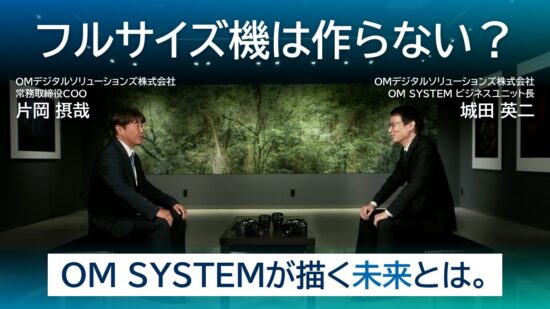
During a recent interview, OM System executives acknowledged that proposals to develop full-frame or APS-C cameras have surfaced repeatedly within the company over the years. Kataoka admitted that shortly after Micro Four Thirds launched, he personally considered expanding into full-frame or APS-C as a future direction; however, a senior colleague challenged him on whether they had truly exhausted the potential of Micro Four Thirds before looking elsewhere. Taking that advice to heart, Kataoka spent the next 15 years focusing on how to push MFT to surpass expectations rather than switching formats. Shirota shared a similar perspective, noting that while he weighed what a transition to full-frame would look like, the unique value OM System wants to deliver requires the compact nature of Micro Four Thirds. Both executives believe that although a physical gap between sensor sizes will always exist, once MFT image quality reaches a threshold that fully satisfies users, the difference ceases to matter – allowing OM System to forge its own R&D path by creating things that don’t yet exist in the world rather than following competitors into the crowded full-frame market.
Recap of the interview:
- Full-frame question: Proposals to build APS-C or full-frame cameras have surfaced internally many times over the years, appearing and disappearing without ever becoming a decision.
- Why they stayed with Micro Four Thirds: The value OM wants to deliver (compact, tough, go-anywhere systems) can only be realized with MFT, so neither executive felt compelled to build a full-frame body.
- The gap argument: The gap with full frame will never fully close, but once image quality reaches a level users are satisfied with, that gap stops mattering — a vision they say has been playing out.
- No “better” format: Full frame has its strengths, MFT has its own; customers should choose by use case — portability favors MFT, chasing the absolute best shot may favor full frame.
- Fixing MFT bottlenecks: Base sensor performance has improved, and features like High Res Shot compensate for weaknesses such as resolution, so “this is missing, therefore it’s no good” complaints have dropped sharply.
- Memorable works: Shirota cited photos shot at minus 40°C thanks to dust/splash/low-temperature sealing, and a snake photo taken after a three-day trek into the Amazon using only their system. Kataoka was most moved by photographer Tetsuro Shimizu’s Mongolia work — days of travel on horseback with camping gear, where a small system was the only way the cameras could even come along.
- Philosophy: “A camera is worth only as much as you carry it.” Kataoka recalls Olympus-era predecessor Yonetani’s words: “Do you know the condition for taking a good photo? Carrying a camera.” Gear should be light enough that you think “maybe I’ll bring one more lens.”
- Business expansion: The optical and manufacturing expertise built through MFT cameras and lenses earned trust from outside companies and seeded other businesses (OM Inotech, OM Kogaku Precision) — the camera know-how is the source of the group’s wider expansion.
- The future: OM SYSTEM aims to be the number-one outdoor brand, guided by its tagline “add more adventure to your life,” supporting new photographers and enriching camera life. The belief that photography enriches life is a conviction they won’t waver from.