Kai Reviews The Panasonic GH5

Kai reviews the Panasonic GH5 and seems pretty impressed, but is looking forward to the firmware update that’s coming. Not an overly informative video, but typical Kai. Below several tests and demos of what the Panasonic GH5 can do recreating famous scenes and shooting in slow motion.

Panasonic GH5 B&H Photo / Amazon / Adorama

Read More »

Posted in Panasonic| Tagged | Leave a comment

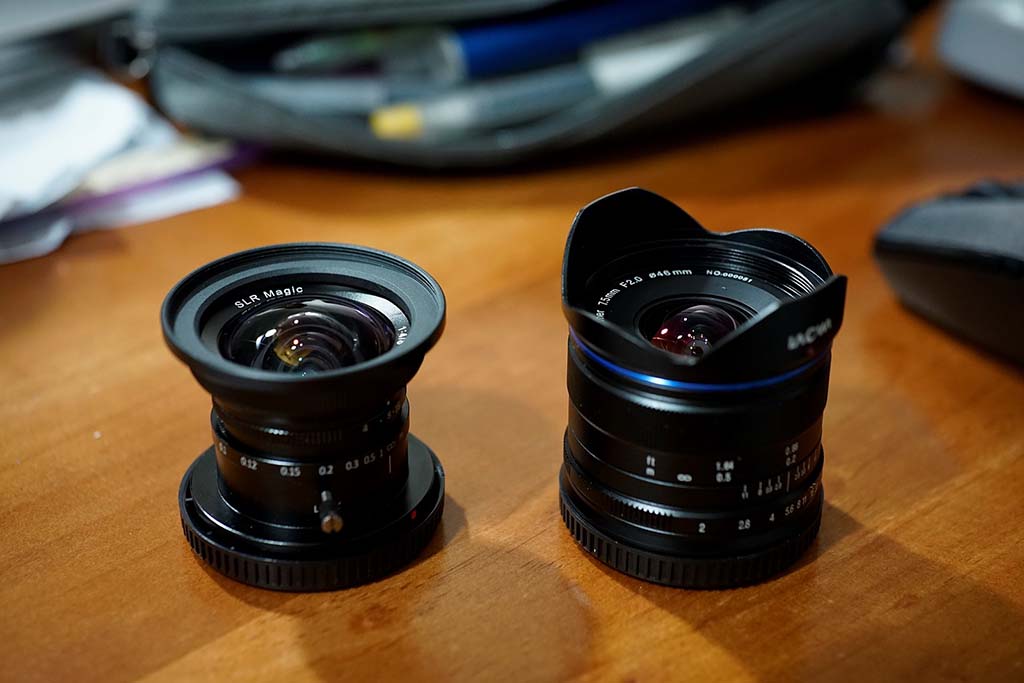
SLR Magic 8mm f/4 Now Available

SLR Magic 8mm f/4 lens: SLR Magic expands its micro four thirds lineup with new ultra wide angle lens
Hong Kong, China (Feburary 25, 2017) – SLR Magic expands the micro four thirds lens lineup with the new SLR Magic 8mm F4 ultra wide angle lens. The product will be officially introduced during upcoming BVE 2017 fair in Excel London.

The field of view corresponds to a 16mm lens in 35mm format and this fast wide angle of view opens up many new creative composition opportunities, particularly in the fields of interior, architectural and landscape cinematography and photography. Additionally, light weight and compact size of the SLR Magic 8mm F4 ideal for aerial photography as well as multi-camera setup 360 VR.

We place our highest priority in the development on our lenses to fulfill the demands of professional cinematographers and photographers. The design and build of the SLR Magic 8mm F4 is solid and reliable.

The SLR Magic 8mm F4 (MSRP: $349 US) will be available from authorized SLR Magic dealers starting March 2017.

The SLR Magic 8mm F4 will be first presented at the BVE 2017 show. The SLR Magic stand would be in (S1-8 G30 Holdan Ltd.) during the BVE show which are to be held in Excel London from Feburary 28th to March 2nd 2017.

https://vimeo.com/205525395

Available Via: B&H Photo

Technical Data:

  • SLR Magic 8mm F4
  • Lens Type: Ultra wide-angle lens
  • Compatible Cameras: All micro four thirds mount cameras
  • Optical Design: 9 elements in 8 groups
  • Distance range: 0.10m to ∞
  • Aperture: Manually controlled diaphragm, 7 aperture blades , Lowest value 16
  • Angle of view: 140 degrees
  • Bayonet: micro four thirds
  • Filter Mount: Internal thread for 43mm filters; filter mount rotates while focusing. Filter adapter (included) for 52mm filters
  • Surface Finish: Black anodized
  • Dimensions – Length to bayonet mount: approx. 41.4mm (approx. 1.63in)
  • Largest diameter: approx. 46.1mm (approx. 1.81in)
  • Weight: approx. 110g (approx. 3.9oz)

Via Photorumors

Posted in 3rd Party Lens| Tagged , | Leave a comment

BlackMagic Camera and DaVinci Resolve Press Conference

https://youtu.be/XXAVGEiSA_c

No new products announced, but relevant to BlackMagic fans that use DaVinci Resolve.

Posted in Blackmagic Design| Tagged | Leave a comment

Panasonic GH5 10bit Flaws in Vlog and Coverage Round-Up: Updated

Cinima5D has completed their extensive review of the Panasonic GH5 and while the over all results are very good, but they discovered a few issues.

“It seems that none of these cameras truly records 1.1 billion colors and, unless my skin is made up of distinct color patches, there seems to be more to “10-bit color” than we know. Having tested and evaluated many camera sensors here at cinema5D, I can tell you this: none of this camera tech is as easy and simplistic as it might seem.”

“As for the Panasonic GH5… There really seems to be a problem with Vlog’s bit depth and colors, with skin tones being particularly problematic.”

You can read their full review here, which also includes a free LUT if you sign up for their news letter. You can also use the official Panasonic Vlog to rec709 LUT if you don’t want to sign up for their news letter.

UPDATE: EOSHD Responded to Cinima5D’s criticisms here, while they didn’t offer any evidence for their interpretation of the data they are a very respectable videography site. It will be interesting to see how this topic develops.

Cameralabs also did a comparison between the Panasonic GH5, Olympus OM-D EM1 Mark 2, Fujifilm X-T2, and Sony a7SII. Their review is still in progress, but I’m surprised with how well the Panasonic GH5 keeps up with larger sensors all the way up to ISO 3200.

“In the video I compare the low-light quality of the Lumix GH5, Olympus OMD EM1 II, Fujifilm XT2 and Sony A7s II in 4k 25p at 1600 ISO to their maximum movie sensitivities of 12800, 6400, 12800 and 409600 ISO respectively. Each camera was set to the same colour temperature and using its standard profile. I used lenses which delivered roughly the same field of view and adjusted the distances where necessary – the Sony samples look different due to the perspective of a longer lens and bigger sensor. The lighting was fixed and the exposures matched at each sensitivity, so any difference in brightness here is due to processing styles and variations in actual sensitivity.”

Finally Photogear news took the Panasonic GH5 to Iceland

Panasonic GH5 B&H Photo / Amazon / Adorama
Olympus OM-D E-M1 Mark II B&H Photo / Amazon / Adorama

Posted in Olympus, Panasonic| Tagged , , , , , , , | 1 Comment

Olympus Interview by Imaging-Resource at CP+ 2017


A very lengthy, but informative interview with Haruo Ogawa and Toshiyuki Terada from Olympus. The bullet points cover the key points, but the lengthy autofocus and sensor discussions are interesting. I imagine they will eventually design chip based instruction sets to speed up some operations, while reducing power consumption, but it will most likely come from Sony when it happens.

  • Olympus OM-D Mark II Doing better than expected
  • Kumamoto Earthquake delayed the launch which was originally intended for Photokina
  • Most OM-D Mark II users are previous owners or people upgrading from E-M5/E-M10
  • Olympus is the original manufacturer of dust reduction technology and builds their cameras to be incredibly robust
  • The Olympus OM-D Mark II AF was designed with 18 AF scenarios in mind, but rivals only design their cameras for 10. The OM-D Mark II performs 1.5 better than the original OM-D at these 18 AF scenarios. There is still room for improvement.
  • One of the 8 extra Scenarios is a bird taking off, where an OM-D Mark II performs better than the competition thanks to their stabilization system because everything is in motion.
  • The Olympus OM-D Mark II is has two quad core chips.
  • In five years the system will be able to do 4x as much.
  • They discuss core functions of the camera into the chip to reduce energy consumption and how Samsung was working on it before exiting the camera market.
  • Sensors noise levels might be approaching their physical limits.
  • Output devices are a limiting factor for bit depth today.
  • They are planing for the wider dynamic range and resolution of 4k and 8k displays.
  • GPS and a compass could be used to get even more stabilization beyond 6.5 stops in the future.
  • The more stops of stabilization you want the bigger the body has to be to allow movement so not all models will be capable of reaching 6.5+ stops of stabilization.
  • TG-series successor in the works.
  • Olympus 12-100mm f/4 and 25mm f/1.2 have been well received by fans and reviews and they couldn’t have been built 2 years ago.

Now is also a great time to pick up an Olympus OM-D Mark II with the current trade in coupon that can be used without trading in a camera.

Via Imaging-resource


Posted in Olympus| Tagged | 1 Comment