


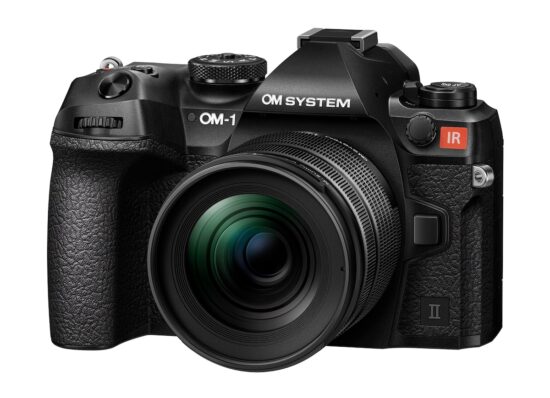
OM System announced a new OM-1 Mark II IR (infrared) camera in Japan (OM System also has an OM-3 ASTRO camera):
- Announcement: Officially announced by OM Digital Solutions on April 9, 2026, exclusively in Japan for business, industrial, scientific, educational, and research users.
- Core Modification: Based on the standard OM-1 Mark II, but with the IR-cut filter removed from the ~20.4MP stacked BSI Live MOS Micro Four Thirds sensor, enabling sensitivity to near-infrared light (approx. 800–1100nm) for capturing hidden details invisible to the human eye.
- Filter System: Includes a set of detachable magnetic filters — one for IR transmission and one for visible light (UV/IR cut) — allowing quick switching between infrared and normal shooting modes without changing lenses.
- Retained Features: Keeps nearly all capabilities of the standard OM-1 Mark II, including TruePic X processor, up to 80MP handheld/tripod Hi-Res Shot, advanced computational tools (Live ND, depth synthesis/focus stacking), 120 fps burst shooting, Pro Capture, AI subject detection, 8.5-stop in-body image stabilization, weather-sealed magnesium body, and tethered shooting support.
- Limitations: Not optimized or guaranteed for general visible-light photography quality equivalent to the standard model; primarily a specialized tool rather than a consumer camera.
- Applications: Designed for non-destructive testing and analysis, such as industrial inspection (wafers, glass, defects), food safety, forensics, cultural heritage/art research (underdrawings, material differences), and scientific spectral analysis.
- Kit Contents: Available as a kit with the M.Zuiko Digital ED 12-45mm F4.0 PRO lens plus the magnetic filter system.
- Availability: Sold only in Japan through OMDS’s business store (biz.om-digitalsolutions.com) for corporate customers; pre-orders started April 9, 2026, with release in mid-May 2026. Buyers must acknowledge its specialized use. Pricing and international availability not announced outside Japan.
- Positioning: A more compact and cost-effective alternative to traditional dedicated infrared systems; not intended for artistic infrared photography (sensor-converted standard bodies are still preferred for that). This is the first OM System-branded IR model (following prior Olympus-era IR variants).
Additional information can be found here.