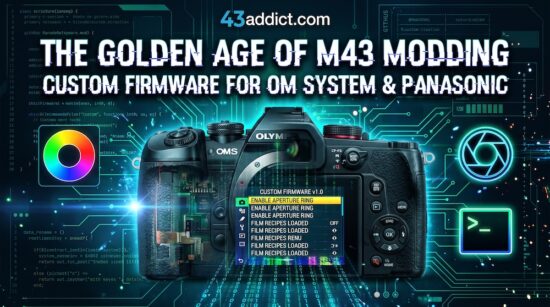
A growing wave of unofficial firmware modifications is giving OM System (and older Olympus) Micro Four Thirds cameras features the manufacturers never shipped. Parallel research continues on the Panasonic side. These community projects enable things like working aperture rings on Panasonic lenses, expanded color controls, film simulations, higher frame rates, and more. Several independent projects have appeared on GitHub and community forums in late 2026:
What’s Available for OM System / Olympus
- db / “Korean” firmware (azqeurio/om-c-firmware): One of the more broadly compatible patches. It enables the aperture ring on many Panasonic Leica lenses in A and M modes on OM bodies (something that has long been a requested feature), adds 12.5 and 16.7 fps options for SH2 and Pro Capture SH2 on the OM-1, electronic shutter sound through the speaker, 5 GHz Wi-Fi hotspot support, Korean menu improvements, and various button/exposure customizations (especially on the E-P7). Tested models include the OM-1, OM-3, OM-5/OM-5 II, E-M1 Mark III, several E-M5 and E-M10 generations, and the PEN-F. The tool downloads official firmware, verifies it, and applies small binary patches.
- Caduceus (for the PEN E-P7 and OM-3): Turns the color profile controls into a full film-look system. On the OM-3, it adds multiple named looks per COLOR profile (up to 20 total), per-color Hue and Lightness adjustments, NR options, Glow/Clarity, white-balance shifts, art effects, and tone-curve controls, all switchable via the dial. A browser-based Control Panel lets users load, tweak, and export film recipes. The E-P7 version goes further with dozens of film simulations, experimental Live ND, minimum shutter speed in Auto ISO, and more. Installation requires the correct stock firmware version (typically 1.1) and a simple patcher.
- PEN-F HSL patches (fishcu/oly_fw_analysis): Extends the classic PEN-F color profiles with full Hue/Saturation/Lightness controls per color channel, building on deep reverse-engineering of the TruePic VII platform. Ready-to-install packages are available, and the underlying analysis repository covers multiple Olympus/OM models.
The Lumix Side: From PTools to GM1/GM5 Firmware Decryption
Panasonic hackers actually pioneered Micro Four Thirds modding back in the legendary GH1 and GH2 days with Vitaliy Kiselev’s PTools, which famously turned consumer hybrid cameras into high-bitrate cinema monsters. For years afterward, stronger encryption kept modern Lumix firmware relatively locked down, limiting users to button-combo service-menu tweaks to bypass the 30-minute EU video record limit or swap NTSC/PAL regions.
Now, the walls are coming down on the Lumix side again. Reverse-engineers on GitHub have successfully cracked the encryption on ultra-compact fan favorites like the Lumix GM1 and GM5, allowing firmware binaries to be decrypted, modified, and flashed directly back to the camera. With both Olympus/OM and Lumix binaries being mapped out simultaneously, community coders are actively exploring deeper cross-brand lens communication fixes, custom video bitrates, and even fine-tuning the onboard AI subject-detection tensor models.
Community links:
- OM-c-firmware (“db firmware”) Tweak Tool on GitHub / Reddit r/M43 Thread
- Olympus PEN-F Firmware Analysis on GitHub / Reddit r/M43 Thread
- Michael Guthmann’s Byte-Level Analysis of OM System Unofficial Firmware
- PhotographyTalk: Caduceus OM-3 Custom Firmware Overview